The main difference between mid-drive and hub motor commuter e-bikes lies in how they deliver power. Mid-drive motors are positioned near the crankset, using your bike’s gears for better efficiency and performance on hills. Hub motors are integrated into the wheel hub, offering simpler setup and lower initial costs but less efficiency on challenging terrain. Want to find out which option matches your riding style? Keep exploring to learn more.
Listen free for 30 days with Audible
Thousands of audiobooks and originals — cancel anytime.
As an affiliate, we earn on qualifying purchases.
Key Takeaways
- Mid-drive motors are positioned near the crankset, utilizing bike gears for improved efficiency and terrain adaptability.
- Hub motors are integrated into the wheel hub, offering simpler design and lower initial cost with easier maintenance.
- Mid-drive systems excel on hilly terrain and long commutes, maximizing battery life through gear optimization.
- Hub motors provide straightforward operation, making them ideal for flat urban routes and users prioritizing simplicity.
- The choice depends on riding habits: mid-drive suits varied terrain and efficiency, while hub motors suit flat, urban commuting.
When choosing a commuter e-bike, understanding the key differences between mid-drive and hub motor systems can help you make an informed decision. One of the most important factors to weigh is how each system impacts battery longevity and motor efficiency. These elements directly influence your riding experience, maintenance needs, and overall value of the e-bike.
Mid-drive motors are positioned near the crankset and work by spinning the chainring directly, which makes them highly efficient. Because they leverage the bike’s gears, you can optimize your pedaling effort, especially on varied terrain. This gear advantage allows you to use the motor more efficiently, which can help extend battery life over longer commutes. Since motor efficiency is maximized, you’ll find that mid-drive e-bikes often have better battery longevity when used properly, especially if you ride frequently or on hilly routes. The ability to shift gears means you can reduce strain on the motor, making it run cooler and more sustainably over time.
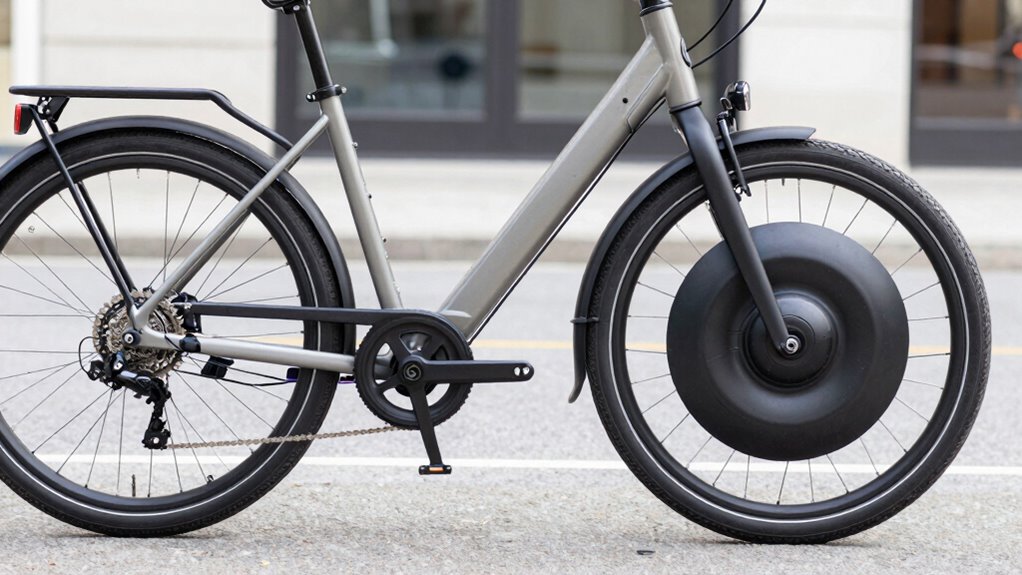
In contrast, hub motor systems are integrated into either the front or rear wheel hub. They tend to be simpler and more straightforward, which often translates to lower initial costs and easier maintenance. However, because hub motors are less flexible in terms of gear utilization, they can be less efficient on diverse terrains, particularly when climbing hills or riding against strong headwinds. This reduced efficiency can lead to quicker battery drain, which impacts battery longevity. You might find yourself charging more often, especially if your commutes involve frequent stops or challenging terrain.
Beyond efficiency, the placement of the motor influences handling and weight distribution. Mid-drive motors tend to distribute weight more evenly, providing a natural feel and better stability. This can improve your control and safety, especially on complex urban routes. Hub motors, being located in the wheel, can add weight to one side, potentially affecting balance, but they also typically add less complexity to the bike’s overall design. Additionally, the development and refinement of motor technology continue to improve the performance and efficiency of both systems. Furthermore, advancements in battery technology are helping to mitigate some of the efficiency drawbacks associated with hub motors.
Ultimately, your choice depends on your riding habits. If you prioritize riding efficiency and longer battery life, a mid-drive system might suit you better. If simplicity and lower upfront costs are more appealing, then a hub motor could be the way to go. Both systems have their pros and cons, but understanding how each impacts motor efficiency and battery longevity will help you select an e-bike that fits your daily commuting needs.
As an affiliate, we earn on qualifying purchases.
Frequently Asked Questions
Which Motor Type Is Better for Hilly Terrains?
For hilly terrains, a mid-drive motor is better because it offers superior motor power and terrain adaptability. It leverages the bike’s gears, giving you more control and efficiency on steep inclines. You’ll find it easier to handle challenging climbs with better torque and balance. Hub motors can struggle in these conditions, often providing less power and less adaptability, making mid-drive systems the smarter choice for hill riding.
How Do Maintenance Costs Compare Between Mid-Drive and Hub Motors?
Imagine you own a mid-drive e-bike, and you notice the motor needs servicing more often than a hub motor. Generally, hub motors have lower maintenance costs because they have fewer moving parts and are easier to replace. When comparing battery lifespan and cost, hub motors tend to be cheaper to maintain over time, while mid-drives might require more frequent repairs. So, your total cost comparison favors hub motors for lower upkeep.
Are There Any Legal Restrictions for Each Motor Type?
Legal restrictions vary depending on your location and the motor classifications of your e-bike. For example, some areas limit motor wattage or top speeds, especially for hub motors, which are often classified as Class 1 or 2 e-bikes. Mid-drive motors may also face restrictions, but regulations tend to focus more on overall power and speed limits. Always check local laws to verify your e-bike complies with legal requirements before riding.
Which Motor Type Offers Better Battery Efficiency?
Mid-drive motors generally offer better battery efficiency because they optimize power consumption and distribute weight evenly, reducing strain on the battery. This leads to improved battery longevity, allowing your e-bike to run longer on a single charge. Hub motors, while simpler and often less expensive, tend to use more power for the same distance, resulting in quicker battery drain. So, if efficiency is your priority, mid-drive motors are the better choice.
How Does Motor Weight Affect Bike Handling?
Motor weight considerably impacts bike handling because motor placement alters handling dynamics. A heavier motor placed centrally, like in mid-drive bikes, improves balance and stability, making turns smoother. Conversely, a heavier hub motor at the wheel can make steering feel less agile and more affected by weight shifts. So, lighter motors generally enhance handling, while heavier ones, depending on placement, can challenge your control and maneuverability.
As an affiliate, we earn on qualifying purchases.
Conclusion
Ultimately, choosing between mid-drive and hub motor e-bikes depends on your daily demands and riding dreams. Mid-drives master mountain climbs with muscle, while hub motors hustle through city streets with ease. Imagine yourself gliding gracefully or powering through peaks, each motor type shaping your journey. Decide which drives your desire — the robust rush of mid-drive or the smooth spin of hub power — and let your e-bike elevate every adventure, energizing every ride with effortless excitement.
As an affiliate, we earn on qualifying purchases.
urban electric bike with hub motor
As an affiliate, we earn on qualifying purchases.
As an affiliate, we earn on qualifying purchases.
Fall Picks
fall essentials
As an affiliate, we earn on qualifying purchases.