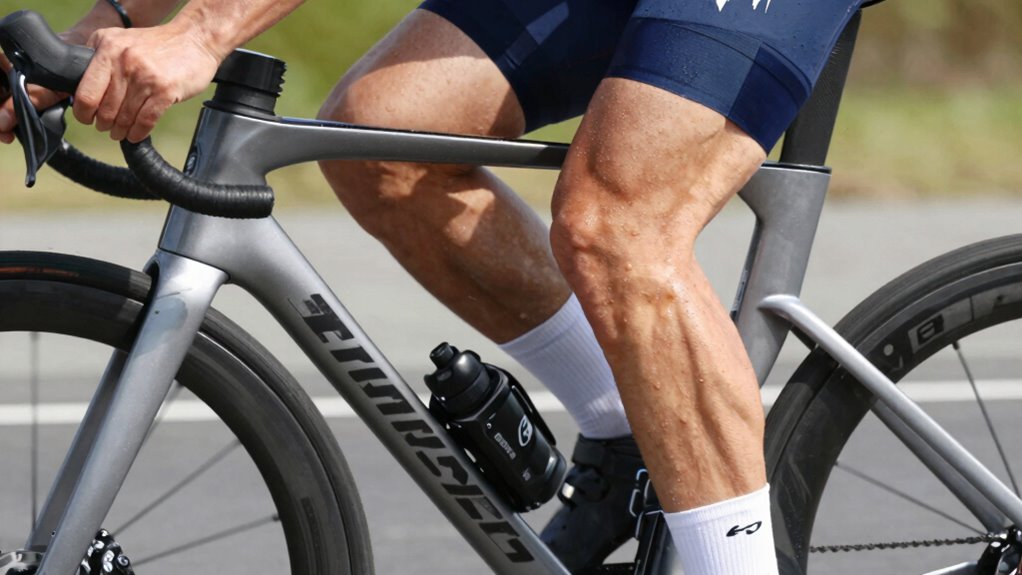

To make certain your bike fit is spot-on, focus on knee-to-pedal alignment. Adjust your saddle height so your knee has a slight bend at the bottom of each pedal stroke, and position your saddle fore-aft so your kneecap lines up over the pedal axle at 3 o’clock. Keep your knee tracking smoothly over the pedal without wobbling inward or outward. Correct alignment boosts comfort, prevents joint stress, and enhances performance—discover how fine-tuning can make all the difference.

Get bike and ride gear delivered free with Prime
- Fast, free delivery on millions of items
- Prime Video, Amazon Music and more included
- Member-only deals all year
Key Takeaways
- Ensure your saddle height allows nearly full leg extension without locking the knee at the bottom of the pedal stroke.
- Position your saddle so your kneecap aligns directly over the pedal axle when the pedal is at 3 o’clock.
- Check that your knee tracks smoothly over the pedal during pedaling, with no outward or inward movement.
- Confirm the cleats are properly aligned, with the ball of your foot over the pedal axle for optimal biomechanics.
- Use a slight bend at the bottom of the pedal stroke to verify proper saddle height and knee positioning.
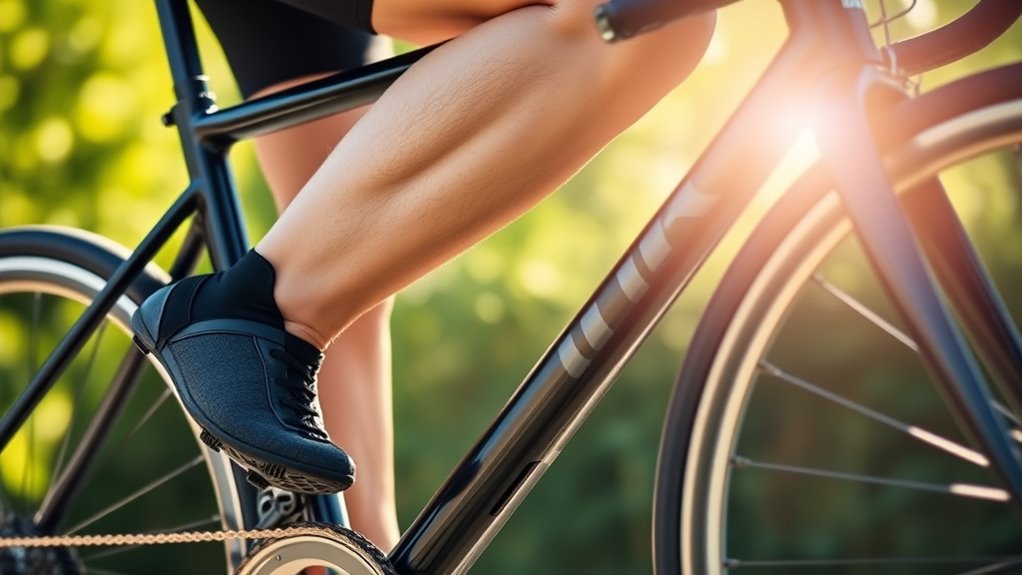
Have you ever wondered if your bike fit is optimized for comfort and efficiency? If so, you’re not alone. Many cyclists overlook the importance of proper knee-to-pedal alignment, which plays a vital role in preventing discomfort and enhancing your performance. Understanding how cycling biomechanics influence your fit can make all the difference. When your bike fit is off, it can lead to unnecessary strain on your knees, hips, and lower back, ultimately causing fatigue or injury. That’s why paying attention to ergonomic adjustments, particularly at the pedal and knee junction, is essential.
The key to a proper knee-to-pedal alignment is ensuring your knee tracks smoothly over your pedal during each pedal stroke. If your knee pushes outward or inward, it indicates that your saddle height or fore-aft position might need adjustment. To maximize this, you should check your cleat positioning carefully. Proper cleat alignment ensures that your knee stays in line with the pedal axle throughout the pedal cycle, reducing undue stress. This process involves fine-tuning your cleats so that the ball of your foot is directly over the pedal axle, which helps maintain ideal cycling biomechanics.
When making ergonomic adjustments, start by adjusting your saddle height. Your saddle should be at a height that allows your leg to extend nearly fully at the bottom of the pedal stroke without locking your knee. A simple way to test this is by performing a slight bend test—your knee should have a slight bend when the pedal is at the bottom. Once your saddle height is correct, move on to fore-aft positioning. Your saddle should be positioned so that when your foot is on the pedal at the 3 o’clock position, your kneecap is aligned over the pedal axle. This alignment ensures that your knee is neither pushed forward nor pulled backward during pedaling, which minimizes strain and maximizes efficiency. Additionally, proper knee-to-pedal alignment can help prevent long-term joint issues and improve overall cycling comfort.
bike saddle height adjustment tool
As an affiliate, we earn on qualifying purchases.
As an affiliate, we earn on qualifying purchases.
Frequently Asked Questions
How Often Should I Check My Knee-To-Pedal Alignment?
You should check your knee-to-pedal alignment every few rides, especially if your cycling posture or saddle height changes. Regular checks help guarantee proper knee tracking and prevent injuries. Pay attention to any discomfort or pain, and adjust your saddle height accordingly. A quick knee-to-pedal alignment check keeps your fit ideal, enhancing comfort and efficiency on the bike. Make it a routine to maintain the best cycling posture.
Can Improper Alignment Cause Long-Term Injuries?
Improper alignment can definitely cause long-term injuries, especially if you overlook issues like limited ankle mobility or an incorrect saddle height. These misalignments put extra stress on your knees, hips, and lower back, leading to overuse injuries over time. Regularly checking your knee-to-pedal alignment helps catch problems early, ensuring your bike fit promotes healthy movement and prevents long-term damage. Don’t wait—your body’s well-being depends on it.
What Tools Are Best for Adjusting My Bike’s Fit?
To adjust your bike’s fit, use tools like an Allen wrench for saddle height and handlebar reach adjustments. A torque wrench guarantees you tighten components correctly without over-tightening. Consider a bike fit gauge or a level to check saddle height and handlebar alignment precisely. Properly adjusting these elements helps prevent injury, improves comfort, and enhances your riding efficiency. Regularly check and fine-tune your fit for ongoing comfort.
Is Professional Bike Fitting Necessary for Beginners?
You might think you can master bike fitting on your own, but honestly, professional bike fitting isn’t just for pros. It’s worth it for beginners who want perfect alignment and comfort. Using the right alignment tools, a fitter can identify issues you’d never spot. So, skip the guesswork, get a professional bike fitting, and enjoy a smoother, pain-free ride—because your knees and back will thank you.
How Does Knee Alignment Affect Pedaling Efficiency?
Knee alignment directly impacts your pedaling efficiency and can reduce knee pain. When your knees track properly over your pedals, you use energy more effectively, preventing unnecessary strain. Misalignment causes inefficient pedal strokes and increases discomfort, especially during long rides. Ensuring correct knee-to-pedal alignment helps you pedal smoothly, minimizes knee pain, and boosts overall performance, making every ride more comfortable and efficient.
As an affiliate, we earn on qualifying purchases.
Conclusion
Now that you know how vital knee-to-pedal alignment is, don’t assume you’re perfectly aligned—check it yourself. A simple adjustment could release new comfort and efficiency on your ride. But what if your current setup is subtly sabotaging your performance? The real question is, are you ready to discover the hidden potential waiting just beneath the surface? Take a moment, verify your alignment, and see what surprises your bike has in store. The difference might just change everything.
As an affiliate, we earn on qualifying purchases.
As an affiliate, we earn on qualifying purchases.
Halloween Picks
halloween
As an affiliate, we earn on qualifying purchases.