

The best overall pick is the Hyleton 48V E-Bike Battery Charger, which pairs a standard 54.6V, 2A output with UL listing. For a 36V battery, the EVAPLUS 42V 2A charger is a focused match, while Hyleton’s 3A model is the faster-output option for compatible 48V batteries. The main tradeoffs are battery compatibility, charging speed, connector fit, and documented safety credentials. A charger that fits the plug can still be wrong for the battery’s voltage or chemistry. Read on for the full breakdown of all 15 options and how to choose safely.

Get bike and ride gear delivered free with Prime
- Fast, free delivery on millions of items
- Prime Video, Amazon Music and more included
- Member-only deals all year
Key Takeaways
- Voltage match matters more than plug count: the 42V chargers in this roundup are for compatible 36V lithium batteries, while the 54.6V models are intended for compatible 48V lithium packs.
- Most 48V picks share a 54.6V, 2A output: connector variety and safety documentation, rather than charging speed, separate many of these models.
- Hyleton’s UL-listed 2A model stands out on credentials: it offers the common 48V charging profile without moving to a faster, higher-current charger.
- The 3A Hyleton is the speed-focused exception: its higher output may shorten charging time on compatible batteries, but it is not a safe universal upgrade.
- Adapter-heavy kits trade convenience for uncertainty: five to seven plug tips can help with connector variety, but buyers still need to confirm the exact plug and polarity required by their bike.




| electric bike battery charger | Input voltage | Output | Battery compatibility |
|---|---|---|---|
| 54.6V 2A Charger for 48V Lithi | 100–240V AC | — | — |
| EVAPLUS 42V 2A Charger for 36V | 240V | — | — |
| 48V Electric Bike Charger | 110V | — | — |
| 54.6V 2A Electric Bike Charger | — | 54.6V, 2A | — |
| Hyleton 48V E-Bike Battery Cha | 100–240V | 54.6V, 2A | — |
| 54.6V 2A Electric Bicycle Char | — | 54.6V, 2A | 48V 13S lithium-ion |
| Jucuwe 42V 2A Charger for 36V | — | 42V DC, 2A; 84W maximum | 36V electric bike lithium batteries |
| 54.6V 2A Charger for 48V Lithi | — | 54.6V, 2A | 48V 13S lithium-ion/NMC |
| EVAPLUS 54.6V Charger for 48V | — | 54.6V, 1.5A; 81.9W | 48V lithium, 13S |
| 54.6V 2A Charger for 48V Li-Io | — | 54.6V DC, 2A | 48V Li-ion (13S) only |
| CraogeCoore 54.6V 1.6A Charger | 110V | — | — |
| QKIIP 54.6V 2A Charger for 48V | 100–240V AC | — | 48V 13S lithium-ion batteries only |
| UL-Certified 54.6V 2A Charger | — | 54.6V, 2A, 109.2W | — |
| Fancy Buying 7-in-1 54.6V 2A C | 100–120V | — | 48V–54.6V 13S lithium-ion batteries |
| Hyleton UL-Certified 54.6V 3A | 110V | — | 48V lithium-ion e-bike batteries |
More Details on Our Top Picks
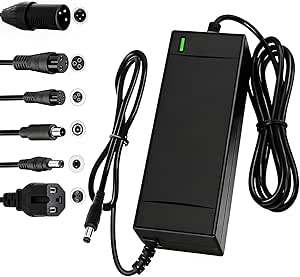
54.6V 2A Charger for 48V Lithium-Ion E-Bikes and Rideables, with 6 Interchangeable Plugs
This is my strongest all-around pick for riders with a compatible 48V lithium-ion battery who are unsure which common connector they need. Its six interchangeable plugs give it broader connector coverage than the Hyleton 48V charger, which includes three types, while the 54.6V, 2A output suits a standard 48V charging setup. Multiple electrical and temperature protections, plus an aluminum-alloy housing designed to dissipate heat, add practical safeguards for routine charging. The charger also supports 100–240V AC input, unlike the RQTFZ model, whose listed input is 110V. The tradeoff is charging speed: at 2A, it may take longer than a higher-current charger, and the extra plugs do not guarantee a match. I’d verify both battery chemistry and connector before buying.
Pros:- Six interchangeable plugs offer more connector options than the three supplied with the Hyleton charger.
- 100–240V AC input supports a wide range of mains supplies.
- Over-voltage, over-current, short-circuit, and over-temperature protections are included.
- Aluminum-alloy housing is designed to dissipate heat.
Cons:- The 2A output may charge more slowly than higher-current alternatives.
- Compatibility still depends on matching the battery’s voltage, chemistry, and charging connector.
Best for: Owners of compatible 48V lithium-ion e-bikes or rideables who want several connector options and broad AC input support.
Not ideal for: Riders seeking a faster charge or anyone with a lead-acid, non-48V, or connector-incompatible battery.
- Output voltage:54.6V
- Output current:2A
- Input voltage:100–240V AC
- Compatible devices:48V lithium-ion e-bikes, scooters, and hoverboards
- Connectors:6 interchangeable plugs
- Safety certification:SGS
- Protection features:Over-voltage, over-current, short-circuit, and over-temperature protection
- Charging behavior:Trickle charging when the battery is full
- Dimensions:1.7 × 1.8 × 4.8 in
Our verdict“Choose this for a compatible 48V lithium-ion battery when connector flexibility and wide input support matter more than charging speed.”
EVAPLUS 42V 2A Charger for 36V Lithium Batteries
Unlike the four 48V-focused chargers in this group, the EVAPLUS is built for a 36V lithium battery, with a 42V, 2A output. That makes it a useful fit for owners of compatible scooters and small rideables who need the correct voltage rather than a broadly featured 48V replacement. Its three connector options and short-circuit, over-current, and over-voltage protections add practical versatility, while its 9.12-ounce weight makes it easy to carry. The limitation is strict compatibility: it is not for 24V or lead-acid batteries, and the listing specifically excludes Hover-1 Ranger and Jetson models using a 3-pin XLR connector. Compared with the 48V Hyleton, it serves a different battery class, not a cheaper substitute. The listed warranty terms also conflict, so I’d confirm coverage before purchase.
Pros:- 42V output is specified for compatible 36V lithium batteries.
- Three connector options accommodate several compatible devices.
- Built-in short-circuit, over-current, and over-voltage protection.
- Compact 9.12-ounce design is convenient to carry.
Cons:- Not compatible with 24V or lead-acid batteries.
- The listing excludes certain Hover-1 Ranger and Jetson 3-pin XLR models.
- Warranty duration is inconsistent between the description and item details.
Best for: Owners of compatible 36V lithium scooters or rideables who need a lightweight charger with a choice of connector types.
Not ideal for: E-bike owners with 48V batteries, 24V or lead-acid packs, or the specifically excluded Hover-1 Ranger and Jetson 3-pin XLR models.
- Output voltage:42V
- Output current:2A
- Input voltage:240V
- Compatible battery:36V lithium
- Connector options:0.31-inch one-prong; 0.31-inch mini 3-prong; 5.5 × 2.5/2.1mm DC female
- Safety certification:SGS
- Dimensions:5.03 × 2.16 × 1.57 in
- Weight:9.12 oz
Our verdict“Pick this only if your device uses a compatible 36V lithium battery and one of its three connectors.”
48V Electric Bike Charger, 54.6V 2A, 13S Lithium Battery Charger with 5 Interchangeable Plugs
The RQTFZ charger is the portability pick among these 48V options: its listed weight is 15.04 ounces, and it includes five interchangeable plugs for compatible 13S batteries. It provides the same 54.6V, 2A output as the ONICYC and Hyleton chargers, so it does not trade charging voltage for a smaller carry load. Its listed device range includes e-bikes, scooters, one-wheel boards, and Rad Power Bike models, though the battery and connector still need to match. The tradeoff is its narrower electrical input listing: 110V, compared with 100–240V on the Hyleton and the first charger in this lineup. It also has one fewer plug than the six-adapter ONICYC. I’d choose it for storage or transport convenience, not for wider mains compatibility.
Pros:- 15.04-ounce listed weight supports portable use.
- Five interchangeable plugs provide multiple connector options.
- Includes over-voltage, over-current, short-circuit, and overheating protections.
- Specified for a range of devices including e-bikes, scooters, and one-wheel boards.
Cons:- The listed 110V input is narrower than the 100–240V input on the Hyleton and first charger.
- Five plugs provide one fewer connector option than the ONICYC charger.
- Compatibility is limited to 13S 48V lithium battery packs.
Best for: Riders with a compatible 13S 48V lithium pack who want a relatively lightweight charger for transport or storage.
Not ideal for: Travelers who need broad 100–240V input support, or owners of batteries outside the specified 13S 48V lithium type.
- Compatible battery:13S 48V lithium
- Output voltage:54.6V
- Output current:2A
- Input voltage:110V
- Interchangeable plugs:5
- Compatible devices:E-bikes, scooters, one-wheel boards, and Rad Power Bike models
- Safety protections:Over-voltage, over-current, short circuit, and overheating
- Weight:15.04 oz
- Specification listed:UL
Our verdict“Choose this when a lighter 48V charger matters more than broad input-voltage support or having six connector adapters.”
54.6V 2A Electric Bike Charger for 48V Li-Ion Batteries with 6 Connector Adapters
The ONICYC is the clearest choice in this group for riders who want to see whether charging is underway or complete: its LED changes from red to green, and the charger has automatic shutoff. Like the first charger, it supplies 54.6V at 2A and includes six connector options, but ONICYC specifies a 48V 13S lithium-ion battery and lists compatible Lectric, Ecotric, and Evercross models. Its UL certification and V-0 flame-retardant enclosure add defined safety credentials. Compared with the Hyleton, it offers twice as many adapters, but its input is limited to 100–120V rather than 100–240V. That makes it less suited to wider mains-voltage use. It is also not a universal 48V charger: other voltages and lead-acid batteries are explicitly excluded.
Pros:- Red charging and green complete indicators make status easy to read.
- Automatic shutoff is specified for a full battery.
- Six connector adapters offer more options than the three included with the Hyleton.
- UL certification and a V-0 flame-retardant enclosure are specified.
Cons:- 100–120V input is narrower than the 100–240V range on the Hyleton.
- Compatibility is limited to 48V 13S lithium-ion batteries.
- Not suitable for lead-acid batteries or other battery voltages.
Best for: Owners of listed or otherwise compatible 48V 13S e-bikes who value visible charge status and automatic shutoff.
Not ideal for: Riders needing 100–240V input, or anyone with a lead-acid battery or a battery voltage other than 48V 13S lithium-ion.
- Model:YLT-546200
- Output:54.6V, 2A
- Input:100–120V, 50/60Hz
- Compatible battery:48V 13S lithium-ion
- Connector adapters:6
- Listed compatible devices:Lectric XP 2.0/3.0, Ecotric City/Beach, Evercross H5/H7
- Safety features:UL certification; over-voltage, over-current, short-circuit, and temperature protection
- Charging indicators:Red while charging; green when complete
- Dimensions:6.5 × 1.5 × 2.5 in
Our verdict“Choose the ONICYC for a compatible 48V 13S bike when clear LED status and automatic shutoff outweigh broad input-voltage range.”
Hyleton 48V E-Bike Battery Charger, 54.6V 2A, UL Listed
The Hyleton is the most straightforward pick here for riders who want a 100–240V input range without carrying a large set of adapters. It supplies 54.6V at 2A for 48V lithium-ion e-bike batteries and includes three connector types: DC barrel, 12mm 3-pin aviation, and 18mm 3-pin XLR. The LED status light and automatic shutoff or trickle behavior give useful charging feedback, while the velvet storage bag helps keep the charger and connectors together. Compared with the six-adapter ONICYC, Hyleton covers fewer connector types, but supports a wider input range. Its safety claims include UL listing and several other stated compliance marks. This is still a connector-specific charger, not a universal option: other voltages and battery chemistries are excluded, and batteries unused for more than 12 months may not charge.
Pros:- 100–240V input offers a wider range than the ONICYC’s 100–120V input.
- Three connector types cover common barrel, aviation, and XLR connections.
- LED status and automatic shutoff or trickle charging provide charging feedback.
- Includes a velvet storage bag and a V-0-rated flame-retardant casing.
Cons:- Three connector types are fewer than the six included with the ONICYC and first charger.
- Only compatible with 48V lithium-ion batteries, not other voltages or chemistries.
- The listing warns that batteries unused for more than 12 months may not charge.
Best for: Owners of compatible 48V lithium-ion e-bikes who need 100–240V input and one of the three listed connector types.
Not ideal for: Riders whose batteries use another voltage or chemistry, need more connector choices, or have a battery unused for more than 12 months.
- Output:54.6V, 2A
- Input voltage:100–240V
- Compatible battery:48V lithium-ion e-bike batteries
- Connector types:DC 5.5 × 2.5/2.1mm; 12mm 3-pin aviation; 18mm 3-pin XLR
- Safety certifications stated:UL listed; also states TUV, SGS, CE, FCC, and RoHS compliance
- Protection features:Overvoltage, overcurrent, short-circuit, and overheating protection
- Housing:V-0-rated flame-retardant casing
- Charging indicator:Green when plugged into the wall or fully charged; red while charging
- Charging behavior:Automatic shutoff or trickle charging when full
Our verdict“Choose the Hyleton if your 48V lithium battery matches one of its three connectors and broad input-voltage support is a priority.”
54.6V 2A Electric Bicycle Charger for 48V Ebike Batteries
I’d shortlist this charger when a 48V 13S lithium-ion battery is confirmed but its charging plug is less common: the main DC connector plus six adapters gives it more connection options than the Jucuwe 42V 2A charger, which is limited to two barrel sizes. Its 2A output suits riders who can accept a steady rather than fast charge, and the red/green indicators and automatic shutoff make charge status easier to check. Over-voltage, over-current, short-circuit, and temperature protections add safeguards, while the flame-retardant enclosure is a useful distinction from the EVAPLUS model’s plastic casing. The tradeoff is strict battery matching: this is only for compatible 48V 13S lithium-ion packs, not lead-acid or other voltages. I’d verify connector fit and polarity before plugging in.
Pros:- Main plug plus six adapters offers several connection options.
- Includes over-voltage, over-current, short-circuit, and temperature protection.
- Automatic shutoff and red/green indicators clarify charging status.
- Flame-retardant V-0 rated enclosure and two-year warranty.
Cons:- Compatible only with 48V 13S lithium-ion batteries.
- The 2A output may charge more slowly than a higher-current compatible charger.
- Connector fit and polarity still need to be checked against the battery.
Best for: Owners of a compatible 48V 13S lithium-ion e-bike who need several connector options and value built-in temperature protection.
Not ideal for: Riders with lead-acid, LiFePO4, or non-48V batteries, or anyone whose port and polarity do not match the included connectors.
- Output:54.6V, 2A
- Input:100–240V, 50/60Hz
- Battery compatibility:48V 13S lithium-ion
- Connectors:Main 5.5 x 2.1mm DC plug plus six adapters
- Protection:Over-voltage, over-current, short-circuit, and temperature protection
- Status and shutoff:Red while charging, green when complete; automatic shutoff
- Dimensions and weight:1.5 x 2.5 x 6.6 in; 1.1 lb
- Warranty:2 years
Our verdict“Choose this for a compatible 48V 13S battery when connector flexibility and temperature safeguards matter more than a faster charge.”
Jucuwe 42V 2A Charger for 36V Electric Bike and Scooter Lithium Batteries
This is the clear pick in this group for a rider with a 36V lithium battery; the 42V charging output matches that battery class, unlike the several 54.6V models here, which are designed for 48V 13S packs. Its two barrel connector sizes cover common 5.5 x 2.1mm and 5.5 x 2.5mm ports, and the 200cm cable gives some extra reach when the outlet is not beside the bike. Red and green indicators show charging progress, with short-circuit, over-voltage, and over-current protection included. The narrower fit is also the main limitation: it does not serve other battery voltages, lead-acid packs, or Razor scooters, and buyers must confirm both connector size and battery chemistry. Unlike the EVAPLUS 54.6V charger, this is a 36V-specific option, not a substitute for a 48V charger.
Pros:- 42V output is specified for compatible 36V lithium batteries.
- Works with two common DC barrel connector sizes.
- 200cm cable offers useful reach from the outlet.
- Status LEDs and short-circuit, over-voltage, and over-current protection are included.
Cons:- Not compatible with battery voltages other than the specified 36V lithium type.
- Connector size must match the battery port.
- One-year warranty is shorter than the warranty listed for the IJCUIJM charger.
Best for: E-bike and scooter owners with a 36V lithium battery and a matching 5.5 x 2.1mm or 5.5 x 2.5mm charging port.
Not ideal for: Owners of 48V batteries, lead-acid packs, Razor scooters, or batteries with a different connector or voltage.
- Output:42V DC, 2A; 84W maximum
- Input:100–240V AC, 50/60Hz, 1.5A
- Battery compatibility:36V electric bike lithium batteries
- Connector:DC barrel, 5.5 x 2.1mm or 5.5 x 2.5mm
- Cable length:200cm (78.7 in)
- Protection:Short-circuit, over-voltage, and over-current
- Charging indicator:Red while charging; green when full
- Warranty:1 year
Our verdict“Pick the Jucuwe when you need a basic 42V charger for a confirmed 36V lithium battery and matching barrel port.”
54.6V 2A Charger for 48V Lithium-Ion E-Bikes and Electric Scooters with 7 Connectors
Among the 48V chargers here, this model makes the most sense for buyers who prefer an aluminum housing and built-in cooling fan over the simpler plastic construction of the EVAPLUS 54.6V charger. It still delivers a modest 2A charge rate, but adds seven interchangeable connectors, status LEDs, automatic shutoff, and protection against overvoltage, overcurrent, overheating, and short circuits. That combination makes it a feature-rich choice for compatible 48V 13S lithium-ion or NMC batteries. The restrictions are unusually important: it explicitly excludes LiFePO4, lead-acid, 52V, 60V, and 72V batteries. Its weight is also higher than the lightweight EVAPLUS unit, so it is less appealing as a carry-along spare. I’d confirm connector fit and polarity before choosing this over the IJCUIJM charger.
Pros:- Aluminum housing and built-in fan are designed to manage heat.
- Seven interchangeable connectors offer broad fit options for compatible devices.
- Includes automatic shutoff and overvoltage, overcurrent, overheating, and short-circuit protection.
- LED indicates charging and full or disconnected status.
Cons:- Restricted to compatible 48V 13S lithium-ion/NMC batteries.
- Not compatible with LiFePO4, lead-acid, 52V, 60V, or 72V batteries.
- At 0.66kg, it is heavier than the EVAPLUS charger listed here.
Best for: Owners of compatible 48V 13S lithium-ion or NMC batteries who want an aluminum-bodied charger with a fan and multiple safety protections.
Not ideal for: Riders with LiFePO4, lead-acid, 52V, 60V, or 72V batteries, or anyone prioritizing a lightweight charger for regular transport.
- Output:54.6V, 2A
- Input:120V
- Battery compatibility:48V 13S lithium-ion/NMC
- Connectors:Seven interchangeable connectors
- Housing and cooling:Aluminum housing with cooling fan
- Safety features:Overvoltage, overcurrent, overheating, and short-circuit protection; automatic shutoff
- LED status:Red while charging; green when full or not connected
- Dimensions and weight:2.72 x 5.96 x 1.85 in; 0.66kg
Our verdict“Choose this over simpler 48V options if the battery is confirmed compatible and a fan-cooled aluminum enclosure is a priority.”
EVAPLUS 54.6V Charger for 48V Lithium Batteries
For riders who want a charger that is easier to pack than the aluminum-bodied 54.6V model, the EVAPLUS is the lightweight 48V option here at 11.2 ounces. It supports compatible 48V 13S lithium batteries, accepts 100–240V AC input, and uses red/green indicators and automatic shutoff to make charging status straightforward. Its 1.5A output is lower than the 2A output on the IJCUIJM and the other 54.6V chargers in this group, so it suits riders willing to trade charging speed for a lighter unit. The connector supports 5.5mm x 2.5mm/2.1mm ports, but that does not remove the need to check fit and polarity. Protection covers over-voltage, over-current, and short circuits; the listed features do not include temperature protection or a fan.
Pros:- 11.2-ounce weight is well suited to carrying in a bag.
- 100–240V AC input supports use across different power systems.
- Automatic shutoff and red/green indicators show charging status.
- Includes over-voltage, over-current, and short-circuit protection.
Cons:- 1.5A output is lower than the 2A output of the IJCUIJM and other chargers in this group.
- Compatible only with 48V 13S lithium batteries.
- Plastic enclosure and listed protections do not include a cooling fan or temperature protection.
Best for: Commuters and touring riders with a compatible 48V 13S lithium battery who value a lightweight charger for carrying as a spare.
Not ideal for: Riders who need faster charging than a 1.5A output can provide, or whose battery is not 48V 13S lithium with a matching barrel port.
- Output:54.6V, 1.5A; 81.9W
- Input:100–240V AC, 2A
- Battery compatibility:48V lithium, 13S
- Connector:DC 5.5mm x 2.5mm/2.1mm
- Protection and shutoff:Over-voltage, over-current, and short-circuit protection; automatic shutoff
- Charge indicators:Red while charging; green when fully charged
- Enclosure and weight:Plastic; 11.2 ounces
- Warranty:12 months
Our verdict“Choose the EVAPLUS if low carry weight matters more to you than charging speed or a fan-cooled housing.”
54.6V 2A Charger for 48V Li-Ion E-Bike and Scooter Batteries with 6 Interchangeable Connectors
This charger is a practical match for a compatible 48V 13S Li-ion battery when the bike’s port is not a standard barrel connection: its six listed connector types include 8mm, 9mm, 12mm, and 3-pin XLR options alongside two barrel sizes. That range gives it a different advantage from the EVAPLUS charger, which lists only barrel connector sizes. The 2A output, 100–240V input, cooling fan, LED status indicator, and automatic shutoff cover useful everyday needs without adding a complicated feature set. But the compatibility boundary is strict: it excludes other voltages, lead-acid, and LiFePO4 batteries. The listed safety feature is automatic shutoff, while the other chargers in this group specify additional electrical protections, so I’d compare the documentation and verify connector fit before purchase.
Pros:- Six connector types include barrel, 8mm, 9mm, 12mm, and 3-pin XLR options.
- 2A output and 100–240V AC input suit compatible 48V charging needs.
- Built-in fan is intended to aid heat dissipation.
- Automatic shutoff and red/green status indication are included.
Cons:- Works only with compatible 48V Li-ion (13S) batteries.
- Not compatible with 24V, 36V, 52V, or 60V batteries, lead-acid, or LiFePO4.
- The listed safety feature is automatic shutoff, with no other electrical protections specified in the product data.
Best for: Owners of compatible 48V 13S Li-ion e-bikes or scooters whose charging port matches one of the six included connector types.
Not ideal for: Riders with 24V, 36V, 52V, or 60V batteries, lead-acid or LiFePO4 packs, or anyone needing clearly specified over-current and short-circuit protections.
- Output:54.6V DC, 2A
- Input:AC 100–240V
- Battery compatibility:48V Li-ion (13S) only
- Connector types:5.5 x 2.1mm, 5.5 x 2.5mm, 8mm, 9mm, 12mm, 3-pin XLR
- Number of connectors:6
- Charging indicator:Red while charging; green when fully charged or on standby
- Cooling and shutoff:Built-in fan; automatic shutoff
- Dimensions:7 x 2 x 5 in
Our verdict“Pick this when a compatible 48V battery needs one of its less-common included connectors, but verify the port and safety documentation first.”
CraogeCoore 54.6V 1.6A Charger for 48V Lithium Batteries with 5 Interchangeable Plugs
The CraogeCoore is the most adaptable pick here for buyers who need one charger for more than an e-bike: its five connector types cover supported scooters, hoverboards, wheelchairs, and mobility devices as well. Its 1.6A output is lower than the 2A QKIIP and Brokeir chargers, so charging may take longer, but that slower pace can suit someone who values broad device coverage over speed. The compact, 0.35 kg body is easier to pack than the larger Hyleton 3A option. Six listed protections and a red/green status light add useful monitoring, though the listed 110V input is less flexible than the QKIIP’s 100–240V input. Match the battery chemistry, voltage, and plug before buying; interchangeable tips alone do not guarantee compatibility.
Pros:- Five connector types support a range of compatible devices.
- Six listed electrical and thermal protections.
- Compact and lightweight at 0.35 kg.
- Red/green indicator distinguishes charging from full charge.
Cons:- Its 1.6A output is slower than the 2A QKIIP and Brokeir options.
- Listed 110V input is narrower than the QKIIP’s 100–240V input.
- Connector fit does not confirm battery-voltage or chemistry compatibility.
Best for: Owners of compatible 48V lithium-powered e-bikes and mobility devices who want a compact charger with several connector options.
Not ideal for: Riders who need faster charging, universal mains-voltage support, or a charger for a battery whose chemistry and port have not been verified.
- Output voltage:54.6V
- Output current:1.6A
- Input voltage:110V
- Connector types:5.5×2.5mm, 8mm 3-prong, 12mm 3-prong, XLR, 8mm coaxial
- Compatible devices:E-bikes, electric scooters, hoverboards, wheelchairs, mobility devices
- Safety protections:Over-voltage, over-current, short circuit, reverse polarity, overheating, surge
- Dimensions:5.5 × 2.4 × 1.3 in
- Weight:0.35 kg
- Indicator:Red while charging; green when fully charged
Our verdict“Choose the CraogeCoore if you need a light, multi-device charger and can accept slower charging and 110V-only input.”
QKIIP 54.6V 2A Charger for 48V E-Bike and Scooter Lithium Batteries, 7 Plug Tips
The QKIIP earns a distinct place for riders who may use different mains-voltage standards: its 100–240V AC input is more travel-friendly than the 110V CraogeCoore or 100–120V Fancy Buying. It supplies 2A, matching the Brokeir charger’s output, and includes seven plug tips for a wider range of charging ports than CraogeCoore’s five. That breadth still has a firm limit: QKIIP specifies 48V 13S lithium-ion batteries only, not lead-acid or other-voltage packs. Its indicator turns green when full, disconnected, or not charging, so green alone does not prove a full battery. Compared with Brokeir, the QKIIP’s clearest advantage is its wider input range; buyers should still confirm the original charger output and connector before use.
Pros:- 100–240V AC input supports a broad range of mains voltages.
- Seven connector tips cover multiple charging-port styles.
- 2A output matches the Brokeir option in current.
- Over-voltage, overload, over-current, over-temperature, and short-circuit protection.
Cons:- Limited to 48V 13S lithium-ion batteries.
- Green indicator can also mean disconnected or not charging.
- Connector-tip variety does not replace checking the battery label and original charger output.
Best for: E-bike and scooter owners with a confirmed 48V 13S lithium-ion battery who need a charger that accepts different mains voltages.
Not ideal for: Owners of lead-acid, LiFePO4, or non-48V batteries, or buyers who need a green light to indicate full charge unambiguously.
- Output voltage:54.6V DC
- Output current:2A
- Output power:109.2W
- Input voltage:100–240V AC
- Battery compatibility:48V 13S lithium-ion batteries only
- Included connector tips:5.5×2.1mm DC, 5.5×2.5mm DC, 9mm 3-prong, 12mm 3-prong, 8mm RCA, 3-pin male XLR, 3-prong female universal
- Protection features:Over-voltage, overload, over-current, over-temperature, short circuit
- Compatible devices:Electric bikes and electric scooters
Our verdict“Pick the QKIIP if you need broad mains-voltage support and have verified that your battery is a compatible 48V 13S lithium-ion pack.”
UL-Certified 54.6V 2A Charger for 48V Electric Bike Batteries
The Brokeir JY-546200 is a good match for riders who want a clear charging routine: its CC-CV charging mode and automatic stop at full charge reduce the need to watch the charger continuously. Its 2A output is on par with the QKIIP and Fancy Buying models, while the stated UL certification and built-in fuse distinguish it on documented protection details. Five connector types offer less variety than the QKIIP’s seven tips, so this is the better fit when one of its included connectors matches your battery—not a substitute for checking the port. It supports 48V lithium batteries, not lead-acid packs. Compared with Hyleton’s 3A charger, the Brokeir trades charging speed for a lower-current 2A output and an explicit full-charge stop.
Pros:- CC-CV charging mode with automatic stop when the battery is full.
- UL certification is specified in the product data.
- Protection includes overvoltage, overcurrent, short circuit, overheating, reverse connection, and a fuse.
- 100–240V AC input and 50–60Hz frequency range.
Cons:- Not compatible with lead-acid batteries.
- Its 2A output is slower than Hyleton’s 3A option.
- Five connector types provide fewer choices than QKIIP’s seven.
Best for: Riders with a compatible 48V lithium e-bike or scooter battery who prefer automatic charge stopping and want a stated UL certification.
Not ideal for: Owners of lead-acid batteries, riders seeking the fastest charging in this group, or anyone whose battery port does not match one of its five connector types.
- Model:JY-546200
- Input:100–240V AC, 50–60Hz
- Output:54.6V, 2A, 109.2W
- Charging mode:CC-CV
- Connector options:DC 5.5×2.1/2.5mm, 12mm aviation plug, Cannon; five connector types included
- Compatible devices:48V lithium-battery electric bikes and scooters
- Safety features:Overvoltage, overcurrent, short circuit, overtemperature, reverse connection, fuse
- Certification:UL
Our verdict“Choose the Brokeir for a compatible 48V lithium battery if automatic full-charge stopping and stated UL certification matter more than higher current or the widest plug selection.”
Fancy Buying 7-in-1 54.6V 2A Charger for 48V 13S Li-ion Batteries
Fancy Buying’s main practical advantage is reach: the 8.2-foot cable can make it easier to charge a bike when the outlet is not close to its parking spot. Seven interchangeable heads also give it more connector options than the Brokeir, and its 2A output matches that model’s current. The limitation is input flexibility: this charger is listed for 100–120V, unlike QKIIP’s 100–240V range, so it is a less suitable travel choice. Its stated compatibility is 48V–54.6V 13S lithium-ion batteries; it is not for 36V or lead-acid packs. The red/green light needs attention too, since green at startup may indicate a fault, and fan noise during operation is normal.
Pros:- Eight-foot cable offers more placement flexibility near the bike.
- Seven interchangeable connector heads support a range of compatible ports.
- 2A output is comparable to the Brokeir and QKIIP models.
- Includes over-voltage, over-current, over-temperature, and short-circuit protection.
Cons:- 100–120V input is narrower than QKIIP’s 100–240V support.
- Not compatible with 36V or lead-acid batteries.
- Fan noise is normal, and a green startup light may signal a fault.
Best for: Owners of compatible 48V 13S lithium-ion e-bikes who need extra cable reach and several connector-head options at home.
Not ideal for: International travelers needing 100–240V input, owners of 36V or lead-acid batteries, or riders who want silent operation or a simple green-light interpretation.
- Output voltage:54.6V
- Output current:2A
- Input voltage:100–120V
- Battery compatibility:48V–54.6V 13S lithium-ion batteries
- Connector heads:Seven interchangeable heads; listed types include 5.5×2.1mm, RCA, 3P-GX12, 3P-GX16, 3P-XLR, 3P plug
- Cable length:8.2 feet
- Safety features:Over-voltage, over-current, over-temperature, short circuit
- Charging indicator:Red: charging; green: full charge or fault
- Certification:UL
Our verdict“Choose Fancy Buying for the long cable and seven heads if your battery is compatible and you will use it on a supported 100–120V supply.”
Hyleton UL-Certified 54.6V 3A Charger for 48V Lithium E-Bike Batteries
Among these five, Hyleton is the speed-focused choice: its 3A output exceeds the 2A Brokeir, QKIIP, and Fancy Buying chargers, which can shorten charging time when the battery supports that rate. That advantage comes with tighter boundaries. Hyleton is specified for 48V lithium-ion e-bike batteries and excludes other voltages, lead-acid, LiFePO4, scooters, and other non-e-bike devices. Its four listed adapter formats may cover a compatible bike, but offer fewer options than QKIIP’s seven plug tips. UL certification, a V0 fire-resistant case, multiple protections, and automatic charging control add practical safeguards; the listed 110V input is less flexible than Brokeir’s 100–240V range. Check the battery’s charging-current requirements and connector before choosing the faster output.
Pros:- 3A output is higher than the 2A Brokeir, QKIIP, and Fancy Buying chargers.
- UL-certified with a V0 fire-resistant case.
- Over-voltage, over-current, short-circuit, and over-temperature protection.
- Automatic charging control and red/green status indicator.
Cons:- Restricted to compatible 48V lithium-ion e-bike batteries; not for LiFePO4 or lead-acid.
- Not intended for scooters or other non-e-bike devices.
- Listed 110V input is narrower than Brokeir’s 100–240V input.
Best for: E-bike owners with a compatible 48V lithium-ion battery that supports 3A charging and who want higher current than the 2A alternatives.
Not ideal for: Owners of scooters, LiFePO4 or lead-acid packs, other-voltage batteries, or riders who need broad input-voltage support and more connector choices.
- Output voltage:54.6V
- Output current:3A
- Input voltage:110V
- Battery compatibility:48V lithium-ion e-bike batteries
- Connector adapters:5.5×2.5mm/2.1mm DC, 8mm Junlei 3015, 12mm 3-pin, 18mm XLR
- Protection features:Over-voltage, over-current, short circuit, over-temperature
- Safety certification:UL
- Case material:V0 fire-resistant
- Dimensions:6.8 × 3.3 × 1.7 in
Our verdict“Pick Hyleton if your 48V lithium e-bike battery supports 3A charging and faster replenishment matters more than broad device or voltage compatibility.”

How We Picked
I ranked these electric bike battery chargers around fit and usable differences rather than treating similar voltage labels as interchangeable. I compared stated output voltage and current with the battery voltage each charger is intended to serve, then considered connector options, named safety credentials, and whether the product’s role is clear from its listed specifications. A correct battery match came before extra plug tips: a charger with many adapters cannot compensate for the wrong charging voltage, chemistry, or polarity.
The top positions go to options with a clearer combination of compatibility, documented safety information, and practical output. The 36V chargers are ranked for their distinct battery fit rather than placed below 48V models simply because their voltage is lower. Where several products list the same 54.6V, 2A output, I distinguish them by stated certification or connector count, while recognizing that the supplied product details do not establish build differences or real-world performance. Buyers should confirm exact battery and connector specifications before purchase.
Factors to Consider When Choosing Electric Bike Battery Chargers
Before choosing by connector count or charging current, check the battery label and your bike maker’s charging requirements. These broader checks help prevent a common mistake: buying a charger that appears to fit but does not match the pack’s electrical or physical needs.
Match the Charger’s Output to the Battery
Start with the battery’s nominal voltage and the charger’s output voltage, not just the bike’s advertised voltage. In this roundup, 42V chargers are specified for compatible 36V lithium batteries, while 54.6V chargers are specified for compatible 48V lithium packs. Those output numbers are charging voltages; they are not evidence that two chargers serve the same battery. Check the battery label, manual, or manufacturer support information for the required charger output. A wrong-voltage charger can fail to charge correctly and may create a safety risk. If the battery documentation is missing or unclear, pause and ask the bike or battery maker before ordering.
Confirm Chemistry and Battery-System Compatibility
A voltage match alone does not prove a charger is suitable for every battery chemistry or battery management system. The models listed here are described for lithium batteries, but buyers should still verify the exact pack type and any manufacturer-specific charging limits. Some e-bike batteries use proprietary systems or communication features that a generic charger may not support. Do not assume a charger for a similarly rated scooter or another bike will work with your battery. Manufacturer guidance takes priority over broad product wording. When replacing an original charger, compare its label with the replacement’s complete output specifications.
Treat Connector Fit as More Than a Plug-Shaped Match
Interchangeable tips can make a charger more adaptable, but the number of tips does not tell you whether the correct one is included. Compare the connector’s shape and size with the battery’s charge port, and check polarity if that information is available. A plug that appears to fit may still have different wiring or contact arrangement. Some bikes also use proprietary connectors or charging protocols that adapter kits cannot replace. If the listing does not identify the exact tip or polarity, contact the seller or manufacturer before connecting it. This extra check matters more than choosing the kit with the longest adapter list.
Choose Charging Current for Your Routine
Higher current can reduce charging time when the battery is designed to accept it, but it should not be treated as a universal upgrade. The 2A models make up most of this roundup, while the Hyleton 3A charger is the higher-output option and CraogeCoore’s 1.6A model is a lower-current alternative. A lower current may mean a longer wait, while a higher one may be unsuitable if it exceeds the battery maker’s limit. Check the pack’s recommended charge current and the original charger label before choosing. For overnight charging, a modest speed difference may matter less than exact compatibility. For frequent turnaround, faster output is useful only when the battery supports it.
Read Safety Credentials Carefully
Certification language can help distinguish products, but it is worth checking what the listing actually identifies and which product model it covers. Hyleton’s 2A charger is listed as UL listed, and two other entries explicitly describe UL certification; that does not make unlisted models automatically unsafe, nor does a phrase in a title replace verification. Look for clear manufacturer details, legible electrical ratings, and instructions for use. Avoid charging a damaged or wet battery, and follow the bike maker’s guidance on where and when to charge. If a charger arrives without a clear label or the stated model does not match the listing, do not connect it until the seller or manufacturer clarifies the discrepancy.
Decide Whether a Spare or Multi-Tip Charger Fits Your Use
A spare charger can be useful if you routinely charge in two locations, but it adds value only when it matches the battery precisely. Multi-tip kits may suit households with compatible devices or buyers who have confirmed their connector among the included adapters. They can be a poor choice when the bike uses a proprietary charger or when the exact polarity is unknown. For a single e-bike, a well-matched charger with clear specifications may be a better fit than a larger assortment of tips. Keep the original charger label as a reference when shopping for a replacement. That simple comparison can prevent an unnecessary return or an unsafe connection.
Frequently Asked Questions
Can I use a 54.6V charger on any 48V e-bike battery?
No. A 54.6V output is commonly specified for 48V lithium-ion packs, but the battery must also match the charger’s chemistry, charging limits, connector, and polarity. Some bikes use proprietary batteries or charging systems that need the original type of charger. Check the battery label and manual rather than relying on the bike’s nominal voltage alone. If those details do not match clearly, ask the battery or bike manufacturer before connecting a replacement.
Is a 3A charger a better choice than a 2A charger?
Only if the battery maker allows a 3A charging current and the charger matches the battery in every other respect. A higher current can shorten charging time, but it is not automatically better for battery health or compatibility. The 2A models in this roundup suit buyers whose batteries specify that current or whose charging routine does not require faster turnaround. Check the original charger and battery documentation before choosing the 3A Hyleton. If the allowed current is not stated, do not assume the pack can accept the higher output.
Will a charger with seven connector tips fit my e-bike?
Not necessarily. Seven tips offer more possible plug shapes, but they do not confirm that the correct size, polarity, or electrical arrangement is included. Some batteries also require a proprietary connector or charging system that a generic adapter kit cannot provide. Compare the charge port with the included tip information and check polarity against the battery or original charger documentation. If the listing does not identify those details, confirm compatibility with the seller or bike manufacturer before purchase.
Can I use a 42V charger on a battery labeled 48V?
Do not use one based on the label alone. The 42V models in this roundup are described for compatible 36V lithium batteries, while the 48V lithium models call for a 54.6V charger. A charger with an output that does not match the battery’s required charging voltage may not charge it correctly and can pose a safety risk. Read the battery label and manual, and compare the required charger output directly. If the specifications conflict or are hard to read, ask the manufacturer rather than experimenting.
Should I buy a generic replacement or the bike maker’s charger?
The bike maker’s charger is the safer starting point when the battery uses proprietary electronics, an unusual connector, or unclear charging specifications. A generic replacement can be a reasonable option when its output voltage, current, chemistry compatibility, connector, and polarity all match the battery maker’s requirements. A broad claim such as “for 48V e-bikes” is not enough by itself. Compare the replacement’s label with the original charger and confirm any certification details that matter to you. If the battery maker requires a specific charger, follow that guidance.
Conclusion
For most buyers with a compatible 48V lithium battery, I would start with the Hyleton 54.6V 2A UL-listed charger as the best overall balance of familiar output and stated safety credentials. The EVAPLUS 42V 2A is the best value-style fit in this lineup for a compatible 36V battery, while Hyleton’s 54.6V 3A model is the premium, faster-output choice only when the battery permits 3A. Beginners should prioritize the charger that matches the original label exactly; the straightforward 2A models are easier to assess than a multi-tip kit with uncertain fit. For buyers who need connector flexibility, compare the five-, six-, and seven-tip options against the actual port and polarity rather than choosing by tip count. If your battery uses proprietary charging hardware or its specifications are unknown, choose the bike maker’s recommended charger instead of guessing.