
TL;DR

Get bike and ride gear delivered free with Prime
- Fast, free delivery on millions of items
- Prime Video, Amazon Music and more included
- Member-only deals all year
Ed Laverack won the British National Hill Climb Championship on a Scott Addict RC Ultimate weighing 5.9kg, according to Cycling Weekly’s report on the bike. Its setup included Brink wheels reported at about 865g, a 92g carbon-and-alloy chainring and lightweight Rockbros pedals. Laverack beat Andrew Feather by 1.2 seconds on the 6.6km Porlock Toll Road course.
Ed Laverack won his second British National Hill Climb Championship on Sunday, beating four-time champion Andrew Feather by 1.2 seconds on Porlock Toll Road. The Welsh rider’s Scott Addict RC Ultimate weighed 5.9kg, with a selection of lightweight components including Brink wheels, Rockbros pedals and a carbon-core chainring, according to Cycling Weekly’s account of the bike.
Laverack completed the 6.6km course in 14 minutes 32.1 seconds, which averaged a 5.5% gradient. Cycling Weekly reported that junior boys champion Erza Bateman was marginally faster overall, while Laverack’s time was enough to secure the senior title. The win ended a seven-year wait for his second national title.
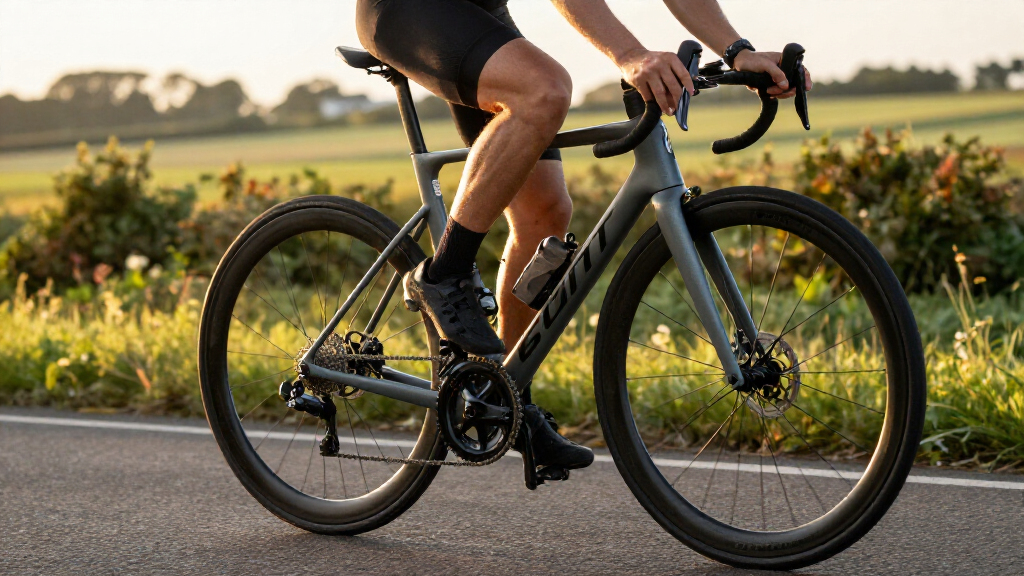
The bike was built around Scott’s Addict RC Ultimate. Scott describes the model as its lightest production road bike; the report gives the size-medium frame a claimed weight of 640g and the fork 270g. Laverack’s Chrome Silver bike was fitted with Brink Velix-Evo 2.0 wheels, reported at approximately 865g for the pair, and Vittoria Corsa Pro Speed 28c tyres set up tubeless.
Other weight-conscious choices included a 92g Gemini Rigel 42-tooth chainring, with a carbon core and 7075-T6 alloy teeth, and Rockbros pedals compatible with Shimano SPD-SL cleats. The pedals are claimed to weigh 180g, with cleats adding 52g. Laverack used SRAM Force cranks with a single-sided Quarq power meter, a 10–26T SRAM Red AXS cassette and a waxed chain. The report attributes the detailed component figures to product specifications or estimates; it does not describe independent weighing of each part.
How the Bike Was Built for the Climb
The build shows how a hill-climb bike can combine low weight with choices shaped by the course, rather than simply using the lightest available part in every category. The Brink wheels weigh more than a shallower wheelset mentioned in the report, but their 37mm depth was selected to balance weight and aerodynamic drag. The report also notes a headwind on the final section, making aerodynamics relevant even on a steep climbing course.
The setup was tightly tailored to Laverack’s ride: a single 42-tooth chainring and 10–26T cassette provided close gearing, while removing the front derailleur reduced weight. Cycling Weekly said Laverack averaged 27kph and did not need a larger sprocket. The result matters to cycling readers as a documented example of how equipment, rider power and course characteristics come together in a championship effort; it does not establish that the components alone produced the win.
Popular right now

Ninja DualZone Smart XL Air Fryer, 10-Qt, 6-in-1, DZ950

Ninja Foodi Smart 6-in-1 Indoor Grill and Air Fryer, 4 Qt, FG551

Shark PowerPro Reveal Plus Cordless Vacuum Cleaner, Charcoal, IZ376H
As an affiliate, we earn on qualifying purchases.
Laverack’s Route to a Second Title
The title followed a strong run of preparation. Cycling Weekly reported that Laverack had won three of four open hill climbs before the championship. The Porlock Toll Road course was longer than usual, a format the report said suited his sustained power. Those factors offer context for the result alongside the bike’s specification.
Laverack’s victory came against Andrew Feather, who had won the national title four times. The 1.2-second margin made the finish close, while the reported 14:32.1 time and the course’s length and gradient give readers a clearer basis for understanding the performance. The bike’s 5.9kg figure is the reported total for Laverack’s build, not a standard specification for every Addict RC Ultimate.
“The Addict RC Ultimate is the brand’s lightest production road bike.”
— Scott, as reported by Cycling Weekly
What the Bike Figures Establish
The source does not provide an independent weighing record for the complete bike or each component. The 5.9kg total is reported for Laverack’s race build, while several component figures are described as claimed, approximate or based on product specifications. It is not clear from the report whether the bike was weighed with every race-required item fitted.
The account also does not provide a full parts list or confirm the exact weight contribution of each substitution. The bike’s finish time and the championship result are reported, but no evidence isolates how much the frame, wheels, pedals or chainring affected the outcome. Laverack’s own comments on the equipment and his race tactics are not included in the supplied source material.
Further Details on the Winning Build
The race result is confirmed in the report, and Cycling Weekly’s bike breakdown records the visible components and their stated or estimated weights. Further precision would depend on additional information, such as an independently verified complete-bike weight or confirmation from Laverack and his team about the final race setup. Until then, readers should treat individual component numbers as reported specifications or estimates, not as a separate audit of the build.
Key Questions
How much did Ed Laverack’s championship bike weigh?
Cycling Weekly reported a total weight of 5.9kg for Laverack’s Scott Addict RC Ultimate race build. The supplied report does not include an independent weighing record.
What was Laverack’s winning time?
He completed the 6.6km Porlock Toll Road course in 14:32.1, at an average gradient of 5.5%, according to Cycling Weekly.
Which lightweight components stood out?
The report highlights Brink wheels at approximately 865g per pair, a 92g Gemini Rigel chainring and Rockbros SPD-SL-compatible pedals claimed to weigh 180g before their cleats.
Did the equipment alone account for the win?
The report does not establish that. It also describes Laverack’s preparation, the course’s fit with his sustained power and his narrow 1.2-second advantage over Andrew Feather. The contribution of individual parts is not quantified.
Source: cyclingweekly.com